
Unlock Math Mastery: How Coloring Activities Make Math Fun and Engaging
Math can often feel like a daunting subject filled with abstract concepts and complex equations. But what if we told you there’s a way to make math not only understandable but genuinely enjoyable? Enter the world of math coloring activities! This article explores how coloring can transform the way we approach math, making it a fun, engaging, and effective learning tool for students of all ages. Get ready to discover how to unlock math mastery, one colorful page at a time.
Why Math and Coloring are a Perfect Match
Combining math and coloring might seem unconventional, but the benefits are numerous and well-documented. It’s more than just a fun pastime; it’s a powerful educational technique. Here’s why:
- Reduces Math Anxiety: Coloring provides a relaxed and creative outlet, which can help ease the stress and anxiety often associated with math.
- Enhances Focus and Concentration: The act of coloring requires focused attention, helping students concentrate on the task at hand, whether it’s solving an equation or identifying a pattern.
- Improves Fine Motor Skills: Coloring strengthens hand-eye coordination and fine motor skills, which are essential for writing and other academic tasks.
- Reinforces Math Concepts: Math coloring activities are designed to reinforce specific math concepts, such as addition, subtraction, multiplication, division, fractions, geometry, and more.
- Makes Learning Visual: Visual aids are incredibly effective for learning, and coloring activities provide a visual representation of math problems, making them easier to understand and remember.
- Increases Engagement and Motivation: By turning math into a fun and creative activity, students become more engaged and motivated to learn. This can lead to improved attitudes towards math and better academic performance.
- Benefits: Reinforces basic arithmetic skills, such as addition, subtraction, multiplication, and division.
- Suitable for: Elementary school students.
- Example: A worksheet where students solve addition problems, and each sum corresponds to a color to fill in a picture of a cartoon character.
- Benefits: Reinforces knowledge of geometric shapes and their properties.
- Suitable for: Preschool and elementary school students.
- Example: A worksheet featuring various geometric shapes like squares, circles, triangles, and rectangles. Each shape is assigned a specific color, and students must color the shapes accordingly.
- Benefits: Helps students visualize and understand fractions, equivalent fractions, and fraction operations.
- Suitable for: Elementary and middle school students.
- Example: A worksheet where students color in fractions of a shape, such as coloring 1/2 of a circle blue and 1/4 of the circle red.
- Benefits: Reinforces coordinate graphing skills and spatial reasoning.
- Suitable for: Middle and high school students.
- Example: Students plot points on a coordinate plane and connect them to reveal a picture of a sailboat, which they can then color in.
- Benefits: Enhances understanding of geometric patterns and spatial reasoning.
- Suitable for: Middle and high school students.
- Example: Students color in a tessellation pattern, such as a pattern made up of repeating hexagons, using different colors to create a visually appealing design.
- Benefits: Reinforces algebraic concepts and problem-solving skills.
- Suitable for: High school students.
- Example: A worksheet where students solve algebraic equations, and each solution corresponds to a color to fill in a picture of a famous mathematician.
- Choose Activities that Match Skill Level: Select activities that are appropriate for the student’s current skill level. Start with simpler activities and gradually increase the difficulty as the student progresses.
- Provide Clear Instructions: Make sure students understand the instructions before they begin. Explain the math concepts involved and how they relate to the coloring activity.
- Encourage Accuracy: Emphasize the importance of accuracy in solving the math problems. Encourage students to double-check their work before coloring in the picture.
- Make it Fun: Create a relaxed and enjoyable atmosphere. Play some music, provide a variety of coloring supplies, and encourage creativity.
- Offer Positive Reinforcement: Praise students for their effort and progress. Celebrate their successes and encourage them to keep learning.
- Incorporate into Lesson Plans: Integrate math coloring activities into regular lesson plans to reinforce concepts and provide a fun break from traditional instruction.
- Use as a Review Tool: Math coloring activities can be used as a review tool to help students reinforce previously learned concepts.
- Adapt to Different Learning Styles: Math coloring activities can be adapted to suit different learning styles. For example, visual learners may benefit from the visual representation of math problems, while kinesthetic learners may enjoy the hands-on aspect of coloring.
- Family Fun: Math coloring activities can be a fun and engaging way for families to spend time together. Parents can work with their children to solve math problems and color in the pictures.
- Summer Learning: Math coloring activities can help prevent summer learning loss by providing a fun way for students to keep their math skills sharp during the summer months.
- Homeschooling: Math coloring activities can be a valuable tool for homeschooling families. They provide a fun and engaging way to teach math concepts and reinforce learning.
- Therapeutic Benefits: Coloring has been shown to have therapeutic benefits, such as reducing stress and anxiety. Math coloring activities can provide a fun and relaxing way to unwind and de-stress.
- Elementary School in California: A study conducted in an elementary school in California found that students who used math coloring activities in their math lessons showed significant improvement in their math test scores compared to students who did not use coloring activities.
- Middle School in New York: A middle school in New York implemented a math coloring program for students who were struggling with math. The program involved using math coloring activities to reinforce concepts and provide a fun way to practice math skills. The results showed that students in the program improved their math grades and developed a more positive attitude towards math.
- Homeschooling Family in Texas: A homeschooling family in Texas used math coloring activities to teach their children math. The mother reported that her children enjoyed the activities and were more engaged in learning math than they had been with traditional methods.
- Online Math Tutoring Program: An online math tutoring program incorporated math coloring activities into its curriculum. The program found that students who used the coloring activities were more likely to complete their assignments and showed greater improvement in their math skills.
- Choose a Math Concept: Select a math concept that you want to reinforce, such as addition, subtraction, multiplication, division, fractions, geometry, or algebra.
- Create Math Problems: Create math problems that relate to the chosen concept. Make sure the problems are appropriate for the student’s skill level.
- Design a Picture: Design a picture that can be divided into sections. You can use a simple geometric shape or a more complex image.
- Assign Colors to Answers: Assign a specific color to each possible answer. Make sure there are enough colors to cover all the possible answers.
- Create a Worksheet: Create a worksheet that includes the math problems and the picture. Include instructions on how to solve the problems and color in the picture.
- Test the Activity: Test the activity to make sure the math problems are accurate and the coloring instructions are clear.
- Get Creative: Don’t be afraid to get creative with your math coloring activities. Use different colors, shapes, and images to make the activities more engaging and fun.
- Concern: It’s Just Play, Not Real Learning.
- Response: Math coloring activities are not just play; they are designed to reinforce specific math concepts and skills. The act of solving math problems and coloring in the picture helps students engage with the material in a fun and meaningful way.
- Concern: It’s Too Time-Consuming.
- Response: Math coloring activities can be incorporated into lesson plans as a fun break from traditional instruction. They can also be used as a review tool or as a supplemental activity for students who need extra practice.
- Concern: It’s Not Challenging Enough.
- Response: Math coloring activities can be adapted to suit different skill levels. Start with simpler activities and gradually increase the difficulty as the student progresses. You can also create your own math coloring activities that are tailored to the specific needs of your students.
- Concern: It’s Only Suitable for Young Children.
- Response: Math coloring activities can be used with students of all ages. There are math coloring activities available for middle school and high school students that focus on more advanced math concepts, such as algebra, geometry, and calculus.
Key Takeaway: Math coloring activities are a fantastic way to make learning more enjoyable and effective. By reducing anxiety, enhancing focus, and reinforcing concepts visually, coloring can transform the way students perceive and understand math.

Types of Math Coloring Activities
The world of math coloring activities is vast and varied, offering something for every age and skill level. Here’s a breakdown of some popular types:
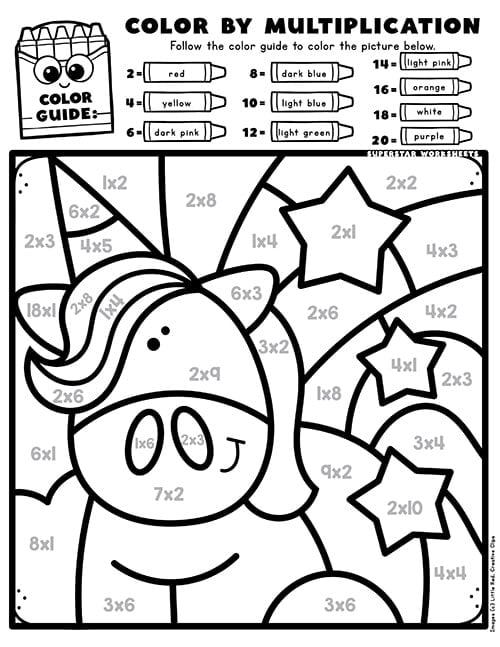
Color by Number Math Worksheets
These worksheets combine basic arithmetic with coloring. Students solve math problems, and each answer corresponds to a specific color. They then color in the corresponding sections of the picture, gradually revealing the image.

Color by Shape Geometry Worksheets
These activities focus on geometry and shape recognition. Students identify different shapes and color them according to the instructions.

Fraction Coloring Activities
Fractions can be a tricky concept for many students. Fraction coloring activities help make fractions more concrete and understandable by using visual representations.
Coordinate Graphing Pictures
These activities combine coordinate graphing with coloring. Students plot points on a coordinate plane and then connect the points to create a picture. They can then color in the picture for added fun.
Tessellations and Patterns
Tessellations are patterns made up of repeating shapes that fit together without any gaps or overlaps. Coloring tessellations can be a fun and creative way to explore geometric patterns.
Algebraic Coloring Activities
These activities combine algebra with coloring. Students solve algebraic equations or expressions, and each answer corresponds to a specific color. They then color in the corresponding sections of the picture.
Internal Link Suggestion: For further exploration of algebraic concepts, link to a comprehensive guide on “Mastering Algebra: A Step-by-Step Guide” using the anchor text “algebraic concepts.”
How to Use Math Coloring Activities Effectively
To maximize the benefits of math coloring activities, it’s important to use them effectively. Here are some tips:
Key Takeaway: Effective use of math coloring activities involves choosing appropriate activities, providing clear instructions, encouraging accuracy, making it fun, and offering positive reinforcement.
Benefits Beyond the Classroom
The benefits of math coloring activities extend beyond the classroom. These activities can also be used at home to supplement learning and provide a fun way for families to spend time together.
External Link Suggestion: For more information on the therapeutic benefits of coloring, link to a relevant article on a psychology website, such as “The Psychological Benefits of Coloring for Adults” on Psychology Today.
Real-World Examples and Case Studies
To further illustrate the effectiveness of math coloring activities, let’s look at some real-world examples and case studies:
Key Takeaway: Real-world examples and case studies demonstrate the effectiveness of math coloring activities in improving math skills, increasing engagement, and fostering a more positive attitude towards math.
Tips for Creating Your Own Math Coloring Activities
If you’re feeling creative, you can even create your own math coloring activities. Here are some tips to get you started:
Internal Link Suggestion: For more creative ideas and resources, link to a blog post on “Creative Ways to Teach Math: Engaging Activities for All Ages” using the anchor text “creative ideas.”
Addressing Common Concerns
Some educators and parents may have concerns about using math coloring activities. Here are some common concerns and how to address them:
Key Takeaway: Addressing common concerns about math coloring activities involves emphasizing their educational value, adaptability, and suitability for all ages.
The Future of Math Education: Embracing Creativity
Math education is evolving, and there’s a growing recognition of the importance of incorporating creativity and engagement into the learning process. Math coloring activities are a perfect example of how to make math more accessible and enjoyable for students of all ages. As educators and parents, we can embrace these innovative approaches to help students develop a love for math and unlock their full potential.
By integrating math coloring activities into our teaching and learning strategies, we can create a more positive and effective learning environment. Let’s continue to explore new and creative ways to make math fun and engaging for all!
Conclusion: Color Your Way to Math Success
Math coloring activities are more than just a fun pastime; they are a powerful tool for unlocking math mastery. By reducing anxiety, enhancing focus, reinforcing concepts visually, and increasing engagement, coloring can transform the way students perceive and understand math. Whether you’re a teacher, a parent, or a student, embrace the power of color and discover the joy of learning math in a whole new way. So grab your coloring pencils, and let’s color our way to math success!
Call to Action: Are you ready to make math fun and engaging? Download our free math coloring activity pack today and start coloring your way to math success! Sign up for our newsletter to receive more tips, resources, and exclusive offers on math education. Share this article with your friends and colleagues and spread the word about the power of math coloring activities!


0 Comments