
Unleash Imagination: Creative Writing Prompts for Elementary Homeschoolers
Creative writing is a fantastic way to boost your elementary homeschooler’s imagination, critical thinking, and communication skills. It’s more than just grammar and spelling; it’s about encouraging self-expression and fostering a love of language. If you’re looking for engaging ways to spark your child’s creativity, you’ve come to the right place! This article provides a treasure trove of creative writing prompts tailored for elementary-aged children, along with tips and tricks to make writing fun and rewarding. Get ready to embark on a literary adventure with your homeschooler!
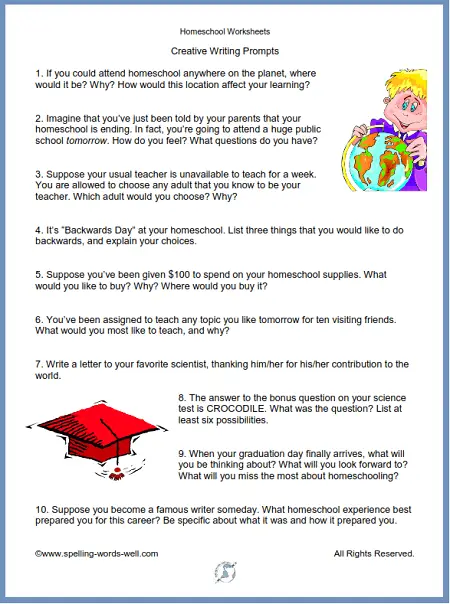
Why Creative Writing Matters for Elementary Homeschoolers
Before diving into the prompts, let’s explore why creative writing is such a valuable activity for elementary homeschoolers. It goes beyond simply fulfilling curriculum requirements.
- Boosts Imagination and Creativity: Creative writing encourages children to think outside the box, explore new ideas, and invent their own worlds. It helps them develop their imaginative muscles and see the world from different perspectives.
- Enhances Communication Skills: Writing allows children to express their thoughts and feelings in a clear and structured way. It improves their vocabulary, grammar, and sentence construction, which are essential for effective communication.
- Develops Critical Thinking Skills: Creative writing often involves problem-solving, decision-making, and analyzing different scenarios. Children learn to think critically about their characters, plots, and themes.
- Fosters Self-Expression and Confidence: Writing provides a safe space for children to explore their emotions, share their experiences, and express their unique perspectives. It can boost their self-esteem and confidence in their abilities.
- Makes Learning Fun and Engaging: Creative writing can transform learning from a chore into an enjoyable activity. By incorporating games, storytelling, and imaginative prompts, you can make writing an exciting part of your homeschool curriculum.
- Narrative Prompts: These prompts encourage children to tell stories, create characters, and develop plots. They often involve a specific scenario, conflict, or goal.
- Descriptive Prompts: These prompts focus on using sensory details to create vivid images and descriptions. They help children develop their observational skills and learn to paint pictures with words.
- Poetic Prompts: These prompts introduce children to the world of poetry and encourage them to experiment with different poetic forms, such as haikus, limericks, and free verse.
- Expository Prompts: These prompts ask children to explain a topic, share their opinions, or provide information. They help develop their research, analytical, and persuasive writing skills.
- Imaginative Prompts: These prompts invite children to explore fantastical worlds, create imaginary creatures, and invent their own rules. They are perfect for sparking creativity and encouraging out-of-the-box thinking.
- The Magical Treehouse: Imagine you find a magical treehouse in your backyard. Where does it take you, and what adventures do you have?
- Encourage your child to describe the treehouse in detail and create a map of the places it visits.
- The Talking Animal: One day, your pet starts talking to you. What does it say, and what do you do?
- Ask your child to consider the animal’s personality and how that influences its conversations.
- The Lost Toy: A toy gets lost in a new house. Write a story about its journey to find its way back to its owner.
- Focus on the toy’s perspective and the challenges it faces in the new environment.
- The Time Traveler: You have a time machine. Where do you go, and what do you change?
- Discuss historical events or future possibilities and how they might be altered.
- The Superhero’s Dilemma: A superhero has to choose between saving a school bus full of kids or stopping a bank robbery. What does the superhero do, and why?
- Explore the ethical considerations and the consequences of each decision.
- The Mysterious Package: A mysterious package arrives at your doorstep with no return address. What’s inside, and what happens when you open it?
- Build suspense by describing the package and its contents in detail.
- The Wish Gone Wrong: You find a magic lamp and get three wishes, but each wish has an unexpected consequence. What do you wish for, and what happens?
- Emphasize the importance of careful planning and considering the potential downsides of wishes.
- The Secret Garden: You discover a hidden garden in your neighborhood. What secrets does it hold, and who takes care of it?
- Focus on sensory details to create a vivid picture of the garden and its inhabitants.
- The Day the Animals Talked: One day, all the animals in the world start talking at once. What do they say, and how does it change the world?
- Encourage your child to consider the perspectives of different animals and the impact of their voices.
- The Adventure in Space: You are on a spaceship exploring a new planet. What do you find there, and who do you meet?
- Encourage creativity in designing the planet, its inhabitants, and their customs.
- Describe Your Favorite Place: Think about your favorite place in the world. What do you see, hear, smell, taste, and feel when you’re there?
- Encourage the use of similes and metaphors to enhance the descriptions.
- Describe a Stormy Day: Imagine you’re watching a storm from your window. What does the sky look like? How does the wind sound? How does the rain feel?
- Focus on the sensory details and the emotions evoked by the storm.
- Describe Your Favorite Food: What is your favorite food? What does it look like, smell like, and taste like? What makes it so special?
- Encourage the use of descriptive adjectives and adverbs to make the food sound irresistible.
- Describe a Dream You Had: Think about a recent dream you had. What happened in the dream? Who was there? How did you feel?
- Emphasize the surreal and illogical aspects of dreams.
- Describe Your Best Friend: What does your best friend look like? What are their personality traits? What makes them a good friend?
- Focus on the qualities that make the friendship special and unique.
- Describe the Inside of a Spaceship: Imagine you are inside a spaceship. What do you see, hear, and feel? What are the controls like?
- Encourage the use of technical terms and futuristic imagery.
- Describe a Haunted House: What does the haunted house look like from the outside? What eerie sounds do you hear when you approach it?
- Focus on creating a sense of suspense and fear through vivid descriptions.
- Describe a Winter Wonderland: Imagine a landscape covered in snow. What does it look like? How does the snow sparkle in the sunlight?
- Emphasize the beauty and serenity of a winter scene.
- Describe a Busy City Street: What do you see, hear, and smell on a busy city street? How do people move and interact with each other?
- Focus on the hustle and bustle of urban life.
- Describe a Desert Oasis: Imagine you are in a desert and stumble upon an oasis. What does it look like? How does it feel to be surrounded by water and greenery in such a dry place?
- Contrast the harshness of the desert with the lushness of the oasis.
- Write a Haiku about Nature: A haiku is a three-line poem with a 5-7-5 syllable structure. Write a haiku about a flower, a tree, or a bird.
- Example: “Green leaves softly sway,nSunlight dances on the bark,nNature’s gentle song.”
- Write a Limerick about a Funny Character: A limerick is a five-line poem with a specific rhyme scheme (AABBA) and rhythm. Write a limerick about a silly character.
- Example: “There once was a cat named Sue,nWho loved to wear shoes that were blue.nShe’d prance down the street,nWith her tiny cat feet,nA fashionable feline, it’s true!”
- Write a Free Verse Poem about Your Feelings: Free verse poems don’t have a specific rhyme or rhythm. Write a poem about how you feel when you’re happy, sad, or angry.
- Encourage children to express their emotions through imagery and metaphors.
- Write an Acrostic Poem using Your Name: An acrostic poem uses the letters of a word (in this case, your name) to start each line of the poem.
- Example (for the name “Emily”):
- Elegant and bright
- Makes everyone smile
- Intelligent and kind
- Loves to read and play
- Youthful and full of joy
- Write a Rhyming Poem about Friendship: Write a poem with rhyming lines about what makes a good friend.
- Example: “A friend is someone kind and true,nWho’s always there for me and you.nThey listen well and understand,nAnd always lend a helping hand.”
- Write a Concrete Poem in the Shape of an Object: A concrete poem is a poem that takes the shape of the object it describes. For example, a poem about a tree could be shaped like a tree.
- Encourage creativity in both the words and the visual representation.
- Write a Color Poem: Choose a color and write a poem about everything that reminds you of that color.
- Example: “Red is the color of fire,nRed is the color of a rose,nRed is the color of a racing car,nRed is the color of my nose when it’s cold.”
- Write a Poem Using Alliteration: Alliteration is the repetition of the same sound at the beginning of words. Write a poem using alliteration.
- Example: “Silly snakes slither slowly,nSliding silently through the sand,nSeeking sunshine, shadows, snacks.”
- Write a Poem Using Personification: Personification is giving human qualities to non-human things. Write a poem using personification.
- Example: “The wind whispered secrets through the trees,nThe sun smiled warmly on the land,nThe river danced merrily along.”
- Write a Poem Inspired by a Painting: Choose a famous painting and write a poem that captures the mood, colors, and story of the painting.
- Encourage children to research the painting and its artist to gain a deeper understanding.
- Write about Your Favorite Animal: What is your favorite animal? Where does it live? What does it eat? What makes it special?
- Encourage children to research the animal and include interesting facts.
- Write about Your Favorite Book: What is your favorite book? What is the story about? Who are the characters? Why do you like it?
- Focus on explaining the plot, characters, and themes of the book.
- Write about Your Favorite Hobby: What is your favorite hobby? How did you get started? What do you enjoy about it?
- Encourage children to explain the steps involved in the hobby and share tips for beginners.
- Write about a Historical Event: Choose a historical event that interests you. What happened? Who were the key people involved? Why is it important?
- Encourage research and the use of reliable sources.
- Write about a Scientific Concept: Choose a scientific concept, such as the water cycle or photosynthesis. Explain how it works in simple terms.
- Focus on clarity and accuracy in explaining the concept.
- Write a Persuasive Essay about a School Rule: Do you think a certain school rule should be changed? Write an essay explaining why.
- Encourage the use of logical arguments and evidence to support their opinion.
- Write a How-To Guide: Choose a simple task, such as making a sandwich or tying a shoelace. Write a step-by-step guide on how to do it.
- Focus on clarity and detail in the instructions.
- Write a Book Review: Choose a book you’ve read recently and write a review. Summarize the plot, discuss the characters, and share your overall opinion.
- Encourage a balanced review that includes both positive and negative aspects.
- Write a Biography of a Famous Person: Choose a famous person who inspires you. Research their life and write a biography highlighting their achievements and challenges.
- Focus on accuracy and the use of reliable sources.
- Write about the Importance of Recycling: Explain why recycling is important for the environment and what steps people can take to recycle more effectively.
- Encourage research on the environmental benefits of recycling.
- Create Your Own Planet: Imagine you can create your own planet. What does it look like? What kind of creatures live there? What are its unique features?
- Encourage creativity in designing the planet’s landscape, climate, and inhabitants.
- Invent a New Holiday: What new holiday would you create? What would people celebrate, and how would they celebrate it?
- Focus on the values and traditions associated with the holiday.
- Design a Futuristic City: Imagine a city in the future. What kind of technology would it have? How would people live and work?
- Encourage creativity in designing futuristic buildings, transportation systems, and social structures.
- Create a Magical Creature: Invent a new magical creature. What does it look like? What powers does it have? Where does it live?
- Focus on originality and creativity in designing the creature’s appearance, abilities, and habitat.
- Imagine You Can Fly: What would you do if you could fly? Where would you go? Who would you visit?
- Encourage children to think about the practical and emotional aspects of flying.
- Invent a New Game: Design a new game. What are the rules? How do you win? What makes it fun?
- Focus on creating a game that is both challenging and enjoyable.
- Create a World Made of Candy: Imagine a world made entirely of candy. What would the houses, trees, and rivers be made of? What would people eat and do?
- Encourage creativity in designing the landscape, architecture, and culture of the candy world.
- Imagine You Can Talk to Animals: If you could talk to animals, what would you ask them? What would you learn?
- Focus on the perspectives of different animals and the insights they could offer.
- Create a Superhero with Unique Powers: Invent a superhero with unique powers. What are their strengths and weaknesses? What kind of villains do they fight?
- Encourage creativity in designing the superhero’s costume, abilities, and backstory.
- Imagine You Are a Character in Your Favorite Book: Which character would you be? What would you do differently? How would you change the story?
- Focus on understanding the character’s motivations and the themes of the book.
- Create a Writing-Friendly Environment: Designate a quiet and comfortable space for writing, free from distractions. Make sure your child has all the necessary materials, such as paper, pencils, crayons, or a computer.
- Set Realistic Expectations: Don’t expect perfection. Focus on the process of writing rather than the final product. Encourage your child to experiment, take risks, and have fun.
- Provide Positive Feedback: Offer specific and encouraging feedback on your child’s writing. Highlight their strengths and suggest areas for improvement in a supportive way.
- Make it a Regular Activity: Incorporate creative writing into your homeschool schedule on a regular basis. Even short writing sessions can help build confidence and improve skills over time.
- Use Games and Activities: Incorporate games, activities, and visual aids to make writing more engaging. For example, you could use story dice, picture prompts, or character-building exercises.
- Read Aloud and Discuss: Read aloud examples of creative writing, such as stories, poems, and essays. Discuss the elements that make the writing effective and engaging.
- Encourage Sharing and Publishing: Encourage your child to share their writing with family members, friends, or online communities. Consider publishing their work in a homeschool magazine or creating a personal blog.
- Be a Writing Role Model: Let your child see you writing. Share your own stories, poems, or journal entries. This can inspire them and show them that writing is a valuable and enjoyable activity.
- Offer Choices and Flexibility: Allow your child to choose prompts that interest them and to write in their own style. Flexibility can help foster a sense of ownership and enthusiasm.
- Celebrate Successes: Celebrate your child’s writing successes, no matter how small. This can boost their confidence and motivate them to continue writing.
- Creative Activities for Kids: Link to a blog post listing other creative activities for kids when mentioning games and activities for writing. Anchor text: “creative activities for kids”
- Reading Resources: Link to a page with recommended reading lists for elementary students when discussing reading aloud examples of creative writing. Anchor text: “reading resources”
- ReadWriteThink: Link to ReadWriteThink for writing prompts and lesson plans for educators. Attribute:
rel="noopener noreferrer"Anchor text: “ReadWriteThink” - Poetry Foundation: Link to the Poetry Foundation for examples of different poetic forms and resources for learning about poetry. Attribute:
rel="noopener noreferrer"Anchor text: “Poetry Foundation”

Types of Creative Writing Prompts
To cater to different interests and skill levels, creative writing prompts can be categorized into several types. Here’s a breakdown to help you choose the best prompts for your elementary homeschooler:

Narrative Writing Prompts: Storytelling Adventures
Narrative prompts are excellent for developing storytelling skills and creating engaging characters.

Descriptive Writing Prompts: Painting with Words
Descriptive prompts help children develop their observational skills and use vivid language to create imagery.

Poetic Writing Prompts: Rhymes and Rhythms
Poetic prompts introduce children to the beauty and expressiveness of poetry.
Expository Writing Prompts: Sharing Knowledge
Expository prompts help children develop their research, analytical, and persuasive writing skills.
Imaginative Writing Prompts: Worlds of Wonder
Imaginative prompts invite children to explore fantastical worlds and create their own rules.
Tips for Making Creative Writing Fun and Engaging
To ensure that creative writing is a positive and enjoyable experience for your elementary homeschooler, keep these tips in mind:
Internal Linking Suggestions:
* Homeschool Curriculum: Link to your website’s page on homeschool curriculum options when discussing incorporating writing into the homeschool schedule. Anchor text: “homeschool curriculum”
External Linking Suggestions:
* NaNoWriMo Young Writers Program: Link to the NaNoWriMo Young Writers Program for resources and support for young writers. Attribute: rel="noopener noreferrer" Anchor text: “NaNoWriMo Young Writers Program”
Conclusion: Ignite the Spark of Creativity
Creative writing is a powerful tool for elementary homeschoolers, fostering imagination, communication, and critical thinking skills. By using these creative writing prompts and tips, you can ignite your child’s passion for writing and help them discover the joy of self-expression. Remember to create a supportive and encouraging environment, celebrate their successes, and make writing a fun and rewarding part of their homeschool journey. Encourage your child to explore different writing styles, experiment with new ideas, and most importantly, enjoy the process of creating their own unique stories and poems. So, grab a pen and paper, and let the writing adventure begin!


0 Comments