
Building Early Literacy: Engaging CVC Word Activities for Young Readers
Introduction
Early literacy lays the foundation for a child’s lifelong relationship with reading, and consonant-vowel-consonant (CVC) words are a cornerstone of that foundation. For kindergarten teachers and homeschooling parents, CVC activities provide an essential bridge between phonemic awareness and independent reading. In this article, you’ll find practical, research-backed strategies and playful activities to help children blend sounds, recognize word patterns, and build confidence. You’ll also learn how to use printable CVC worksheets for kindergarten to extend practice, track progress, and create consistent, high-impact reading practice at home or in the classroom.
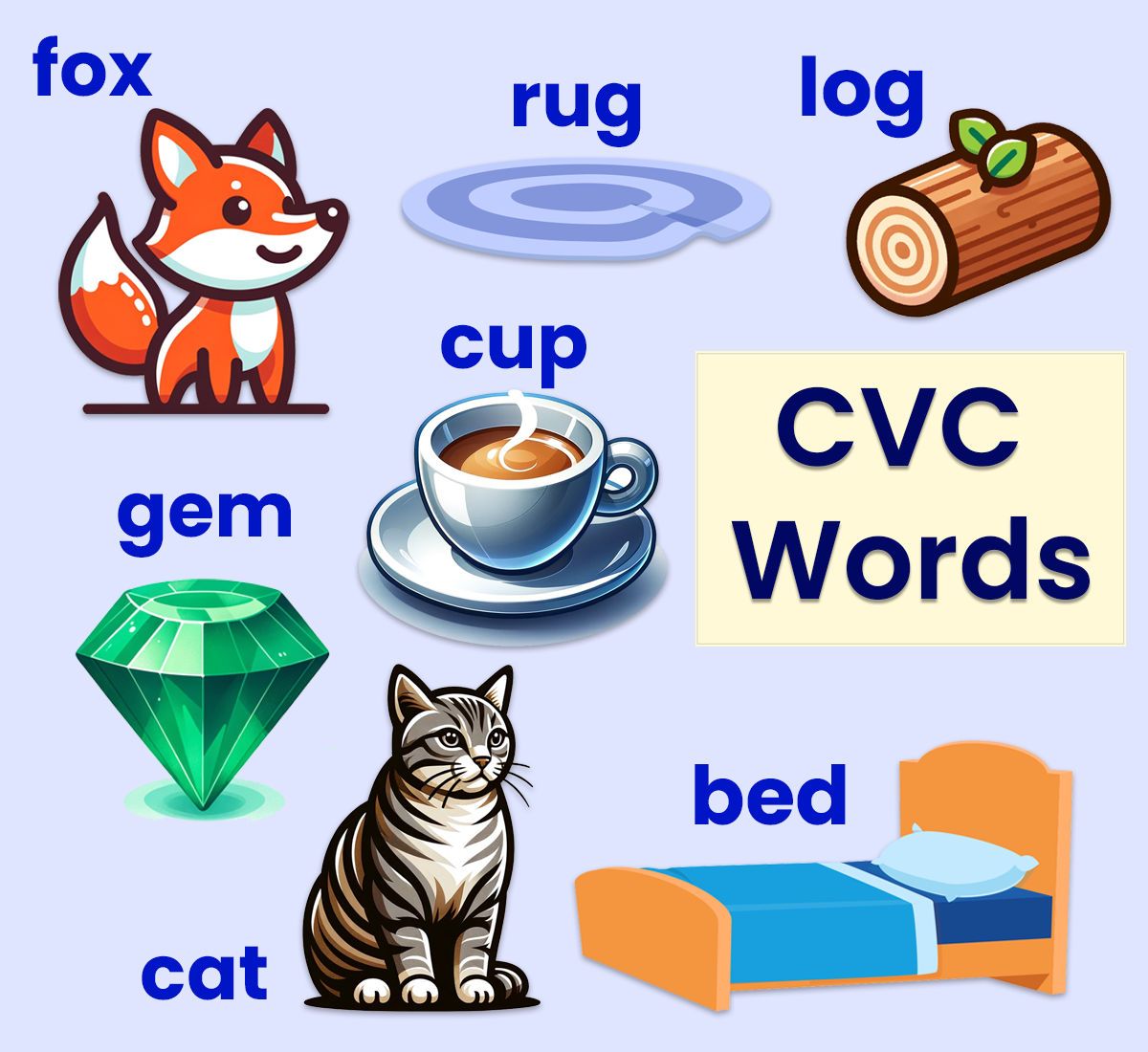
Why CVC Words Matter for Early Literacy
CVC words (e.g., cat, pen, sip) are ideal for beginners because they follow predictable phoneme-grapheme relationships. These short, decodable words:
- Reinforce letter-sound correspondence
- Provide manageable chunks for blending and segmenting
- Boost decoding fluency and early sight-word acquisition
- Build confidence through quick, successful reading experiences
- Echo blending: Say the sounds slowly, have the child repeat, then blend together.
- Stretch-and-tap: Stretch each sound while tapping fingers, then slide hand together to say the word.
- Robot voice to normal voice: Speak in a robot voice for each phoneme, then blend into normal speech.
- Sound boxes (Elkonin boxes): Move a token into a box for each sound and then push them together to read the word.
- Activity: Give children a CVC word from the worksheet and ask them to build it with magnets or cards. For differentiation, give picture clues or ask learners to swap one sound to make a new word (cat → hat).
- Learning target: Letter-sound mapping and decoding fluency.
- Activity: Roll the dice to choose initial, medial, and final sounds and read or write the resulting word. Use the printable worksheet as a template for recording words.
- Learning target: Blending, spelling, and decoding variability.
- Activity: Children match pictures to the correct CVC word strip, then read the word aloud. Extend by asking children to change one letter to create a new word and draw the new picture.
- Learning target: Vocabulary development and phoneme substitution.
- Activity: Students flip through initial-letter pages to create and read family words (cat, bat, sat). Use the printable worksheets for practice and assessment.
- Learning target: Pattern recognition and automaticity.
- Activity: Create hopscotch squares with CVC words or individual sounds. Children hop to read and blend each square, answering a quick question (e.g., “Change the first sound to /h/—what’s the new word?”).
- Learning target: Kinesthetic reinforcement of phonics skills.
- Keep it short and targeted: 5–10 minutes per worksheet focusing on one skill (blending, segmenting, or reading).
- Combine worksheet time with hands-on practice: Follow a worksheet with a game or manipulatives to reinforce the same skill.
- Differentiate: Provide simpler sheets for beginners and challenge advanced students with two-syllable decodable words or word-building tasks.
- Track progress: Use a simple checklist to record which CVC families and blending skills each child has mastered.
- For developing readers: Add medial vowel substitution activities and short timed reads to build fluency.
- For advanced learners: Introduce CVCe contrasts (e.g., cap/cape) and multisyllabic decodable words, or ask learners to write sentences using CVC words from the printable worksheets.
- One-minute reading checks using a list of CVC words
- Running records of decodable text containing CVC words
- Observation checklists during activities (blending independently, segmenting errors)
- Morning warm-up: 5 minutes of sound blending with flashcards
- Midday focused lesson: 10–15 minutes using printable CVC worksheets for kindergarten plus a game
- Evening review: Short read-aloud that highlights decodable CVC words
- Magnetic letters, letter tiles, and Elkonin boxes for hands-on practice
- Decodable readers with CVC focus for guided practice
- Link to your phonics curriculum page with anchor text “homeschool phonics curriculum”
- Link to a blog post on “guided reading strategies” with anchor text “guided reading strategies for kindergarten”
- American Federation of Teachers or International Literacy Association resources on phonics instruction
- National Reading Panel summary for systematic phonics research
- “Kindergarten child blending sounds with letter tiles”
- “Printable CVC worksheets for kindergarten showing word family activities”
- Shareable quote: “Short, playful CVC practice builds big readers.” Use as tweet or Facebook post copy.
Research on phonics-based instruction consistently shows that systematic practice with decodable text and blending activities accelerates early reading development. For kindergarten learners, focusing on CVC patterns supports both phonemic awareness and phonics skills.
Core Skill: Blending Sounds
Blending sounds is the crucial skill of smoothly combining individual phonemes (e.g., /c/ /a/ /t/) to form whole words. Practice should progress from oral blending to assisted decoding to independent reading.
Practical blending strategies:
Engaging CVC Word Activities for the Classroom and Home
These activities are low-prep, hands-on, and perfectly paired with printable CVC worksheets for kindergarten to reinforce learning.
1. CVC Hunt (Hands-on Phonics Scavenger Hunt)
– Materials: Magnetic letters or letter cards, printable CVC lists.
2. Roll-and-Read CVC Game
– Materials: Dice with consonants on two faces and vowels on one, printable boards with CVC word frames.
3. Picture Match and Read
– Materials: Printable CVC picture cards and word strips.
4. Flip Book Word Families
– Materials: Stapled mini-books, printable CVC word family sheets (e.g., -at, -en).
5. CVC Sound Hopscotch
– Materials: Floor tape, printable word cards.
Effective Use of Printable CVC Worksheets for Kindergarten
Printable worksheets are most effective when used as part of a balanced routine, not as rote busywork. Best practices:
Differentiation Tips for Mixed-Ability Groups
– For beginners: Start with consonant-vowel-consonant words where all letters are familiar; use picture supports and physical cues (tap and blend).
Assessment and Progress Monitoring
Quick, informal assessments work well in kindergarten settings:
Use results to inform small-group instruction and to select targeted printable worksheets for follow-up practice.
Integrating Homeschool Phonics Routines
Homeschooling parents can build short, consistent routines around CVC practice:
These short, repeated exposures create the consistency young learners need to internalize letter-sound patterns and gain fluency.
Resources and Classroom Tools
– Printable CVC worksheets for kindergarten (decodable word lists, picture-match pages, word family flip books)
Conclusion
CVC word practice is a powerful, research-supported step in early literacy development. By combining systematic blending instruction with playful, hands-on activities and targeted printable CVC worksheets for kindergarten, teachers and homeschooling parents can help children build decoding skills, reading confidence, and enthusiasm for reading. Keep activities short, varied, and connected to assessment so every child experiences success.
Call to Action
Download our printable CVC worksheets for kindergarten today and boost reading skills! These ready-to-use sheets are perfect for classroom centers, small groups, and homeschool phonics routines—designed to make blending sounds and reading practice fun and effective.
—
Internal linking suggestions:
External link suggestions:
Image alt text suggestions:
Social sharing optimization:


0 Comments