
STEM Learning at Home for Early Learners: Practical Activities, Tips, and Resources
Introduction
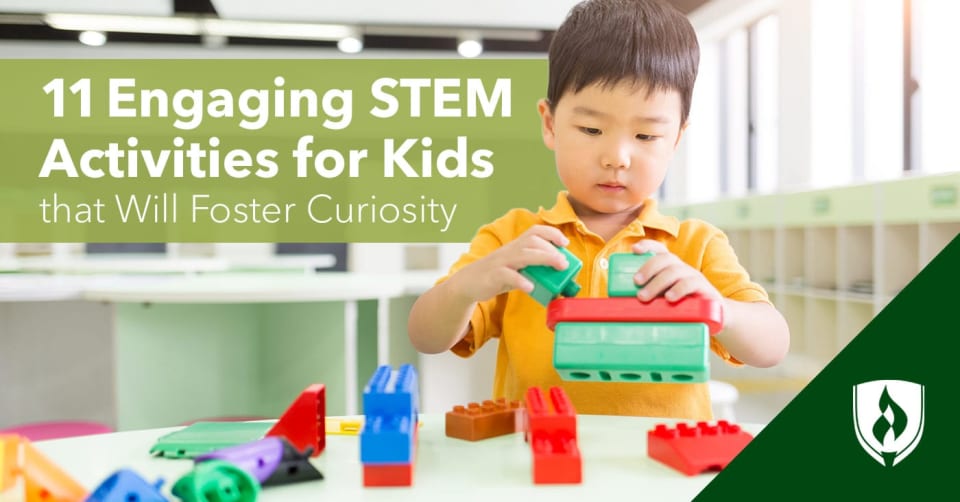
Young children are natural scientists: they observe, ask questions, experiment, and test hypotheses through play. Bringing STEM (science, technology, engineering, and math) learning into the home nurtures that curiosity and builds strong cognitive, social, and problem-solving skills that support school readiness and lifelong learning. This guide explains why early STEM matters and gives you a friendly, practical roadmap to integrate playful, age-appropriate STEM activities into everyday life. You’ll learn simple experiments, engineering challenges, coding and technology introductions, math-rich games, recommended materials, safety tips, assessment ideas, and resources — all designed for preschoolers and kindergarteners. Whether you’re a parent, caregiver, or educator looking for at-home enrichment, this article arms you with clear next steps and ready-to-use activities that make STEM fun, meaningful, and accessible.
Why STEM Learning at Home Matters for Early Learners
Children learn best through active exploration and relationships. STEM at home supports:
- Cognitive development: STEM promotes observation, classification, pattern recognition, and logical thinking.
- Language and communication: Describing experiments and outcomes builds vocabulary and expressive language.
- Fine and gross motor skills: Building, pouring, and manipulating materials refine coordination.
- Social-emotional skills: Collaborative projects encourage sharing, patience, and resilience.
- Future readiness: Early exposure to STEM fosters confidence with technology and problem solving.
- Keep it playful: Turn learning into an engaging game or story.
- Follow the child’s interest: Let questions and curiosities drive the activity.
- Emphasize process over product: Celebrate attempts, not only correct results.
- Scaffold gently: Offer just enough help to keep children challenged but not frustrated.
- Make it routine: Short, frequent STEM moments beat long, rare sessions.
- Use household materials: Learning should be low-cost and easily repeatable.
- Model curiosity: Ask “what if?” and think aloud to demonstrate scientific thinking.
- Measuring cups and spoons
- Funnels, droppers, pipettes
- Clear plastic cups and jars
- Food coloring
- Baking soda, vinegar, salt
- Balloons, straws, tape
- Cardboard, paper, popsicle sticks
- Pipe cleaners, rubber bands
- Magnifying glass
- Ruler, tape measure
- Simple gears/wheels kits or LEGO bricks
- Child-friendly tablet or screen for guided coding apps
- Timer or stopwatch
- Pour milk into the dish to cover the bottom.
- Add drops of different food coloring spaced apart.
- Dip a soap-covered cotton swab into the center and watch colors swirl.
- Invite child to predict whether each object will sink or float.
- Test objects and sort results.
- Talk about why some items float (shape, material, trapped air).
- Line cup with moist paper towel, place seed between towel and cup wall.
- Observe daily and record changes with simple drawings or photos.
- Track daily temperature, rainfall, and sky conditions.
- Create a weather chart using stickers or drawings.
- Challenge child to build a bridge that spans two chairs or stacks.
- Test by rolling a toy car across or placing coins to test load.
- Ask child to design a boat to hold as many small toys as possible without sinking.
- Test different shapes and sizes.
- Build the tallest freestanding tower using a limited number of straws.
- Encourage sketches before building and reflection after.
- Sequencing games: Create “recipe” cards of actions (hop, clap, spin) and have child follow or reorder them.
- Robot role-play: Child or adult acts as a robot following step-by-step commands.
- Pattern programming: Use colored cards to create simple instruction sequences.
- Block-based, drag-and-drop coding games (e.g., early levels of ScratchJr)
- Story-driven apps that require sequencing and choices
- Coding toys with tangible blocks or simple commands (e.g., programmable robots for preschoolers)
- Prioritize apps with clear learning goals and minimal ads.
- Use co-play: sit with the child, ask questions, and extend play.
- Keep sessions short (10–20 minutes) and hands-on.
- Set clear limits and routines for screen time.
- Use screens for interaction, not passive viewing.
- Choose apps that promote creation and problem solving over passive consumption.
- Grocery math: Count apples, compare quantities, make simple addition stories.
- Number hunts: Find numbers hidden around the house and match them to quantities.
- Counting with fingers, blocks, or beads for concrete understanding.
- Use beads or buttons to make repeating patterns (ABAB, AAB).
- Ask the child to extend or create patterns.
- Play rhythm patterns with claps or instruments.
- Baking activities teach volume and estimation.
- Compare lengths with yarn or footsteps.
- Use nonstandard units (blocks, hands) to measure toys, then introduce rulers.
- Puzzle play, block building, and shape sorting.
- Introduce positional language (above, below, between).
- Drawing shapes and making shape collages.
- Cooking: Counting, measuring, chemical changes (baking).
- Cleaning: Sorting laundry by color or size, estimating load sizes.
- Shopping: Budgeting with pretend money, weighing produce, estimating totals.
- Outdoor play: Observe insects, test shadows, make leaf rubbings.
- “What do you think will happen if…?”
- “How could we test that idea?”
- “Can you make a pattern with your toys?”
- Ask open-ended questions: “What do you notice?” “Why do you think that happened?”
- Use descriptive vocabulary: heavier, lighter, sink, float, dissolve, expand.
- Narrate actions: Describe what you or the child is doing step-by-step.
- Encourage storytelling: Ask children to tell a story about their creation or experiment.
- Label materials and results: Build print awareness by labeling charts and drawings.
- Anecdotal notes: Jot down what a child can do, ask, or explain during activities.
- Photo or video documentation: Save short clips to track growth in skills and confidence.
- Portfolio of works: Keep drawings, predictions, and simple data charts.
- Simple rubrics: Note ability to predict, observe, test, and communicate results.
- Language learners: Use visuals, gestures, and modeling. Pair vocabulary with actions.
- Children with sensory needs: Offer tactile-friendly materials and predictable routines.
- Limited materials: Use nature (sticks, stones, leaves) and recyclable materials.
- Small spaces: Try tabletop experiments and portable activity boxes.
- Focus on richness of interaction, not expensive toys.
- Share library or community resources (science kits, maker spaces).
- Encourage diverse representations of scientists and engineers in books and media.
- “Rosie Revere, Engineer” by Andrea Beaty — encourages tinkering and persistence.
- “National Geographic Little Kids First Big Book of Why” — accessible science questions.
- “The Curious Garden” by Peter Brown — exploration and growth themes.
- ScratchJr — introductory block coding for young children.
- Khan Academy Kids — free early learning activities including math and logic.
- Tinkergarten — nature-based play activities for families.
- Simple robot kits for preschoolers (screen-free programmable bots)
- Magnifier sets and bug catching kits
- Building blocks, gear sets, and magnetic tiles
- American Academy of Pediatrics guidance on screen time and child development (external, opens new window)
- PBS Kids for safe, educational games (external, opens new window)
- Local library or maker-space directories (internal link suggestion: /community-resources)
- “Early learning curriculum” — /early-learning-curriculum
- “Parent guides for preschool activities” — /parent-guides-preschool
- “STEM kits and classroom resources” — /stem-kits-resources
- Always supervise experiments involving small parts, heat, or liquids.
- Keep choking hazards out of reach for toddlers.
- Use non-toxic materials and child-safe scissors.
- For experiments with food, consider allergies and hygiene.
- Set up activities on surfaces that are easy to clean.
- “Looking for ways to spark STEM curiosity at home? Try these playful, low-cost activities for preschoolers!”
- “Turn snack time and playtime into learning with our easy STEM guide for early learners.”
- Try one activity this week: Pick the Rainbow Milk Swirl and do it together. Take a photo and note what your child describes.
- Sign up for a weekly STEM email (soft CTA): Provide a simple weekly prompt to keep short, consistent practice.
- Explore community resources: Check your local library for STEM kits and storytime programs.
Research shows that early informal STEM experiences — short, playful, curiosity-driven interactions with adults — predict later interest and persistence in STEM subjects. Encouraging a positive attitude toward problem-solving is as important as teaching facts.

Principles for Successful At-Home STEM with Young Children
Use these guiding principles to design effective activities:
Essential Materials for Home STEM (Low-Cost & Versatile)
Stock these basic supplies for many activities:
Alt text suggestion for header image: “Parent and preschooler doing a science experiment with measuring cups and food coloring.”
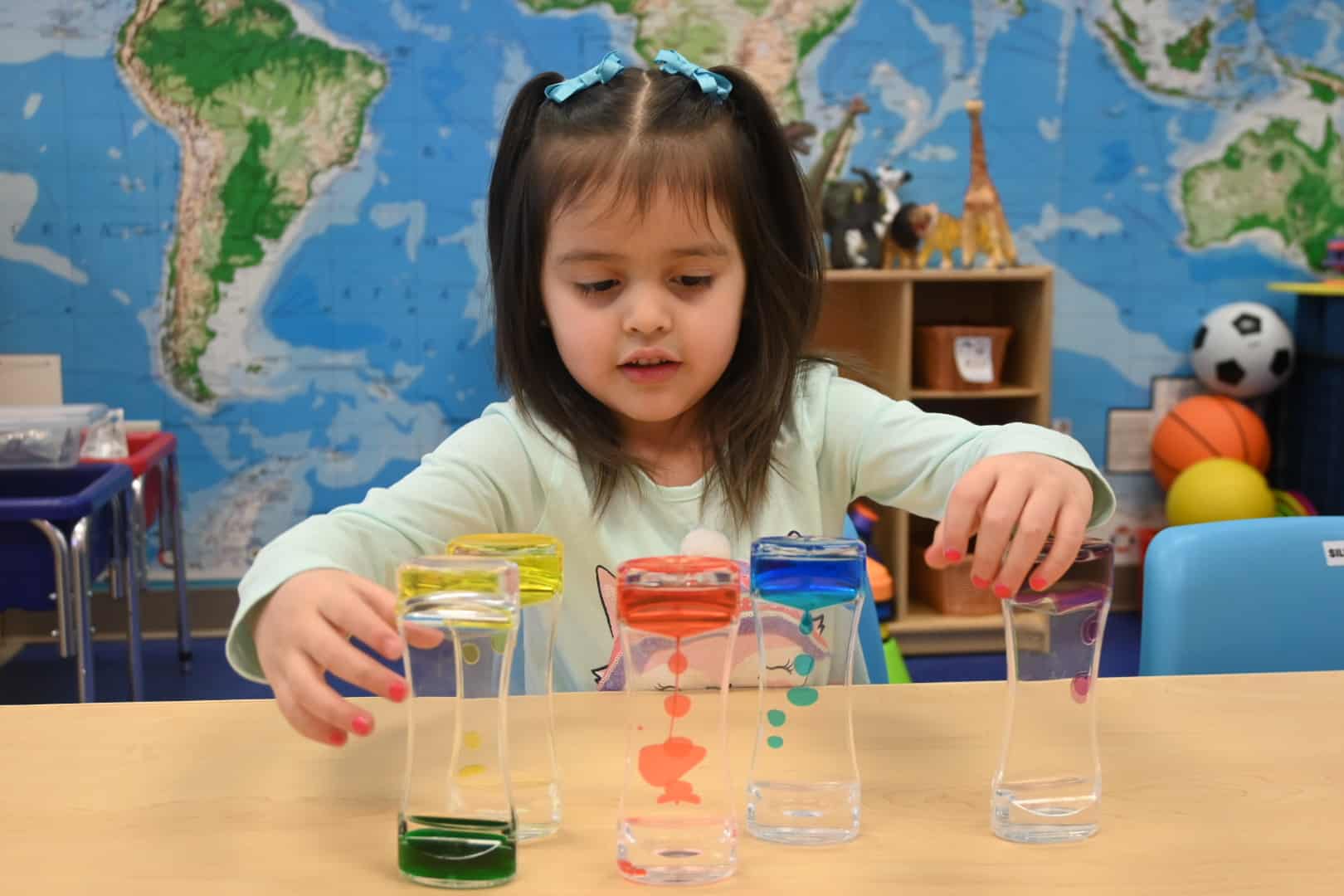
Science Activities for Early Learners
H3: Sensory Science: Rainbow Milk Swirl (Chemistry basics)
Materials: Shallow dish, whole milk, food coloring, dish soap, cotton swab.
Steps:
Learning points: Discuss surface tension, mixing, and cause & effect. Encourage descriptive language (swirl, burst, spread).
H3: Sink or Float (Observation & Hypothesis)
Materials: Small basin of water, assorted household objects (coin, sponge, cork, small toy).
Steps:
Extensions: Create a chart to record predictions vs. outcomes — early data collection.
H3: Planting and Life Cycles (Biology & Responsibility)
Materials: Clear plastic cup, paper towel, bean seed, water.
Steps:
Learning points: Growth, needs of living things, observational recording.
H3: Weather Station (Earth Science & Measurement)
Materials: Thermometer, measuring cup for rain, colored chalk, wind vane materials (optional).
Steps:
Learning points: Measurement, patterns, seasonality, data collection.
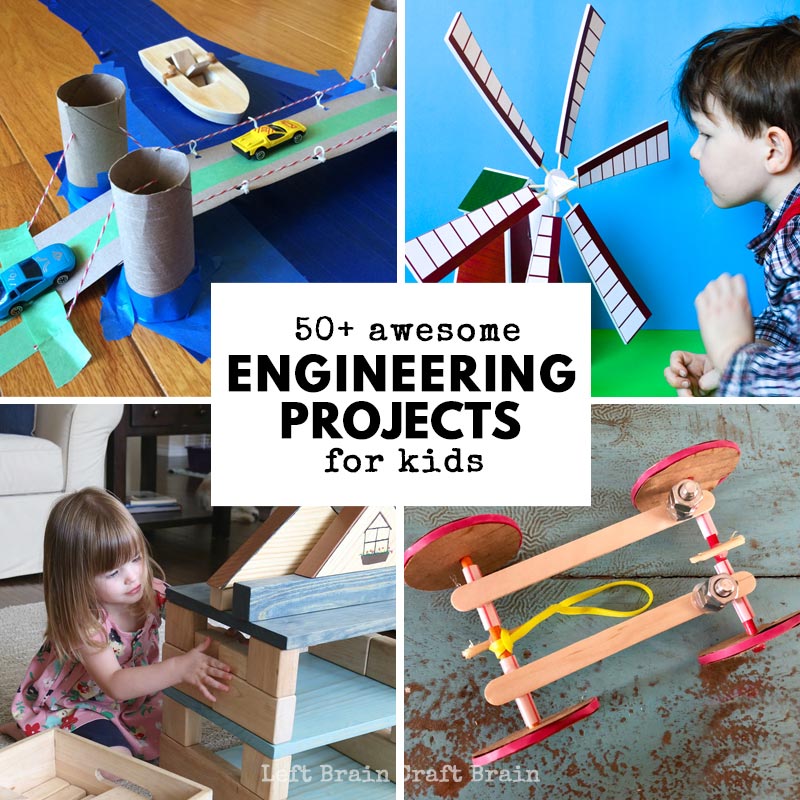
Engineering Activities for Young Children
H3: Block Bridges and Load Testing (Simple Engineering)
Materials: Wooden blocks, toy cars, small weights (coins).
Steps:
Learning points: Design, trial-and-error, balance, support.
H3: Build-a-Boat Challenge (Buoyancy & Design Thinking)
Materials: Aluminum foil, small toys, water tub.
Steps:
Learning points: Iterative design, testing variables like shape and weight distribution.
H3: Straw Towers (Structural Engineering & Teamwork)
Materials: Straws, tape, paper clips.
Steps:
Learning points: Planning, stability, collaboration, optimization.
Technology & Early Coding for Preschoolers
Technology for very young children should emphasize cause-and-effect, sequencing, and creativity rather than syntax. Here are safe, developmentally appropriate introductions.
H3: Unplugged Coding Activities (No Screen Required)
H3: Screen-Based Apps & Toys (Guided, High-Quality)
Recommended types of apps and toys:
Selection tips:
H3: Digital Safety & Screen Balance
Math Activities for Early Learners
Math in early childhood is mostly about number sense, patterns, shapes, measurement, and spatial reasoning. Turn everyday moments into math lessons.
H3: Counting & Number Sense
H3: Pattern Play & Early Algebraic Thinking
H3: Measurement & Comparison
H3: Spatial Reasoning & Geometry
Integrating STEM into Daily Routines
STEM doesn’t require a special time block — integrate it into daily life.
Quick daily STEM prompts:
Supporting Language and Inquiry During STEM
Language and STEM reinforce each other. Use the following strategies:
Include transition sentence: These habits build the foundation for scientific thinking and communication.
Assessment & Tracking Progress (Informal, Play-Based)
Formal testing is unnecessary for early learners. Use observational techniques:
Use observations to personalize challenges: increase complexity, provide new tools, or introduce collaborative tasks.
Adapting STEM for Different Learners and Contexts
Make STEM inclusive and accessible:
H3: Equity-minded Tips
Sample Weekly STEM Plan for Busy Families
This simple plan requires 15–30 minutes daily and uses common materials.
Day 1: Sensory experiment — Rainbow milk swirl (science)
Day 2: Counting & cooking — Make simple muffins, count and measure (math)
Day 3: Build time — Straw tower or block bridge (engineering)
Day 4: Nature walk — Collect leaves and sort by size/color (observation & classification)
Day 5: Unplugged coding — Sequence daily routine cards (technology thinking)
Day 6: Free play — Let child design a “robot” or invention and explain it (creativity)
Day 7: Reflection — Look through photos and drawings; ask questions about what they learned
Case Studies & Real-World Examples
Case Study 1 — Preschool at Home: A parent with a 4-year-old turned morning routine into STEM moments. During breakfast, they counted fruit and measured milk for cereal. On rainy days they built paper boats and tested which designs floated best, encouraging hypothesis-making and drawing results. Over six months the child showed increased willingness to make predictions and describe outcomes.
Case Study 2 — Community Library STEM Kits: A small-town library curated monthly STEM take-home kits (magnifiers, seed packs, simple measuring tools). Families reported that kits increased shared learning time and inspired follow-up experiments at home.
Bold takeaway: Small, consistent STEM interactions at home build big confidence and scientific thinking over time.
Recommended Resources (Books, Apps, Kits)
Books:
Apps & Online:
Kits & Toys:
External link suggestions:
Internal link suggestions (anchor text recommendations):
Safety and Supervision Guidelines
Frequently Asked Questions (FAQ)
Q: How much STEM time does my preschooler need?
A: Short, frequent interactions (10–20 minutes daily) are more effective than long sessions. Integrate STEM into routines and play.
Q: What if I don’t have any science background?
A: You don’t need to be an expert. Model curiosity, ask questions, and follow your child’s lead. Many activities are low-tech and guided by simple cause-and-effect.
Q: How do I balance screen time with hands-on play?
A: Choose interactive, educational apps and pair screen use with hands-on follow-up. Limit passive viewing and maintain routines for non-screen play.
Q: How can I gauge progress without tests?
A: Use photos, anecdotal notes, and simple portfolios to document improvements in observation, explanation, and problem-solving.
SEO & Social Sharing Optimization
Meta title suggestion: “STEM Learning at Home for Early Learners — Activities, Tips & Resources”
Meta description: “Spark curiosity with hands-on STEM activities for preschoolers and kindergarteners. Find science experiments, engineering challenges, coding ideas, math games, and resource recommendations.”
Social share text suggestions:
Suggested featured image alt text: “Parent and toddler building a straw tower together, smiling and experimenting.”
Schema markup recommendation: Add Article schema with headline, author, datePublished, image, publisher, mainEntityOfPage, and keywords [“STEM learning at home”, “early learners”, “preschool STEM”] to improve discoverability in search engines.
Actionable Next Steps (CTAs)
Conclusion
Bringing STEM into your home during early childhood is less about teaching facts and more about supporting curiosity, exploration, and confidence. Short, playful experiences grounded in everyday moments build the foundation for future learning in science, technology, engineering, and math. Use low-cost materials, follow your child’s interests, and celebrate the process. By documenting progress, scaffolding gently, and integrating STEM into routines, families can create rich learning environments that spark a lifelong love of discovery.
Key takeaway: Start small, keep it playful, and make STEM part of everyday life — your child’s curiosity will do the rest.


0 Comments