
STEM Learning at Home for Early Learners: Fun, Hands-On Activities and Practical Strategies
Start early, keep it playful, and watch curiosity grow. STEM learning for early learners (preschool through early elementary) is less about formal instruction and more about building thinking habits: observing, asking questions, experimenting, and solving simple problems. This comprehensive guide offers friendly, research-backed strategies, dozens of hands-on activities, and practical tips to weave science, technology, engineering, and math into everyday family life—without stress or screens taking over.

Introduction: Why STEM Matters for Early Learners (150–200 words)
Children’s brains are primed for learning in the first years of life, and early exposure to STEM concepts helps develop the cognitive and social skills they’ll use throughout school and life. STEM at home doesn’t mean complicated experiments or expensive kits—it’s about playful exploration: building towers, noticing patterns, measuring during snack time, or predicting what will float. Research links early STEM experiences with stronger problem-solving skills, vocabulary development, and long-term interest in STEM fields.
In this article you’ll learn how to create a supportive STEM environment at home, practical activity ideas for ages 3–8, simple daily routines that incorporate STEM thinking, safety guidelines, assessment ideas, and resources for further learning. Whether you’re a caregiver, grandparent, or homeschooler, you’ll find easy, enjoyable ways to grow curiosity and build foundational STEM skills using everyday materials.
Core Principles for STEM Learning at Home
Use these guiding principles to shape experiences that are meaningful, developmentally appropriate, and joyful.
- Play first, instruction second: Young children learn best through play, exploration, and inquiry.
- Process over product: Focus on thinking, not flawless end results. Celebrate questions and attempts.
- Make it hands-on: Concrete, tactile experiences build math and science understanding.
- Follow the child’s interests: Tailor activities to what excites them—dinosaurs, cooking, vehicles—to increase engagement.
- Use everyday moments: Meals, walks, and chores are rich STEM opportunities.
- Language matters: Rich vocabulary and open-ended questions boost learning.
- Clear bins labeled with pictures for loose parts (buttons, corks, beads).
- Basic tools: child-safe scissors, tape, measuring cups, a ruler, magnifying glass, and a notebook for drawings.
- Building materials: cardboard boxes, blocks, LEGO/DUPLO, pipe cleaners, and recycled containers.
- Let children measure ingredients—introduce words like cup, half, more, and less.
- Talk about changes when cooking: solids melting, liquids boiling, or bread rising.
- Compare sizes and tastes; make simple graphs of favorite foods.
- Collect leaves, rocks, or seeds and sort by size, color, or texture.
- Play “I Spy” with shapes, numbers, or patterns in nature.
- Practice estimation: “How many steps to the big tree?”
- Challenge: “How can we put all the blocks away in the smallest number of boxes?”
- Discuss efficiency and problem-solving—counting and strategy naturally follow.
- Invite your child to predict whether each object will sink or float.
- Test each item and talk about results.
- Sort objects into “sink” and “float” piles and count them.
- Challenge: Build a bridge that lets a car drive underneath without touching the ground.
- Test and iterate, encouraging your child to change designs to improve stability.
- Create patterns (AB, AAB, ABC) using found natural items.
- Encourage your child to describe the pattern and predict what comes next.
- Ask your child to design a paper airplane that flies the farthest to a marked target.
- Measure flights, record results, and encourage redesigns based on observations.
- Write simple commands on cards: forward, left, right, jump.
- Create sequences for the toy to follow. Introduce loops by repeating commands.
- Track daily weather—temperature, wind, and rain—for two weeks.
- Discuss patterns and make simple charts or graphs.
- Instead of “Do you see the red ball?”, ask “What do you notice about the ball?”
- Encourage predictions: “What do you think will happen if we add more water?”
- Prompt reflection: “Why do you think that happened?”
- Have children narrate steps during activities and write simple instructions together.
- Create a “science notebook” with drawings, stickers, and short sentences to document discoveries.
- Read picture books that introduce STEM themes—pair the story with an activity to deepen understanding.
- Limit passive screen time; favor apps that promote creativity and problem-solving.
- Use short, interactive video clips to introduce a concept, then follow with a hands-on activity.
- Co-play and discuss what you saw—this increases learning gains.
- Collect photos of projects and brief notes about what children tried and learned.
- Use checklists focused on skills (e.g., counting to 20, using measurement words, making a prediction).
- Revisit earlier activities to observe improvements—measurements and charts are helpful evidence.
- Adapt materials for different motor abilities—use larger grip tools or pre-cut shapes.
- Offer visual supports and step-by-step picture cards for children who benefit from routine.
- Use multilingual labels and incorporate culturally relevant examples and stories.
- Avoid small choking hazards for children under 3; use larger manipulatives instead.
- Use non-toxic materials and keep a first-aid kit nearby for minor mishaps.
- Model safe behavior—wear goggles for messy experiments and explain why safety matters.
- Monday — Nature walk + collection and sorting (20–30 min)
- Tuesday — Building challenge (blocks or recycled materials) (30–45 min)
- Wednesday — Kitchen science (measuring & mixing) (20–30 min)
- Thursday — Pattern and math play (games, pattern collages) (20–30 min)
- Friday — Simple coding or sequencing activity (20–30 min)
- Weekend — Family project (weather station, long-term garden, or construction) (Flexible)
- Books: “Rosie Revere, Engineer” by Andrea Beaty; “What Do You Do With An Idea?” by Kobi Yamada.
- Websites: PBS Kids (games and science resources), National STEM Learning (early years resources), NASA Space Place (child-friendly science).
- Apps: ScratchJr (free, block-based coding for young children), Toca Lab (introductory science play).
- Internal link suggestions: “Early Childhood Development” (anchor: early childhood development), “Homeschool Planning” (anchor: homeschool STEM schedule), “Parental Guides” (anchor: STEM activities for parents).
- External authoritative links: National Science Teaching Association (https://www.nsta.org) for standards and ideas, PBS Kids (https://pbskids.org) for interactive activities, U.S. Department of Education early learning resources (https://www.ed.gov).
- Increased curiosity and willingness to try new things
- Improved vocabulary around cause-and-effect and measurement
- Ability
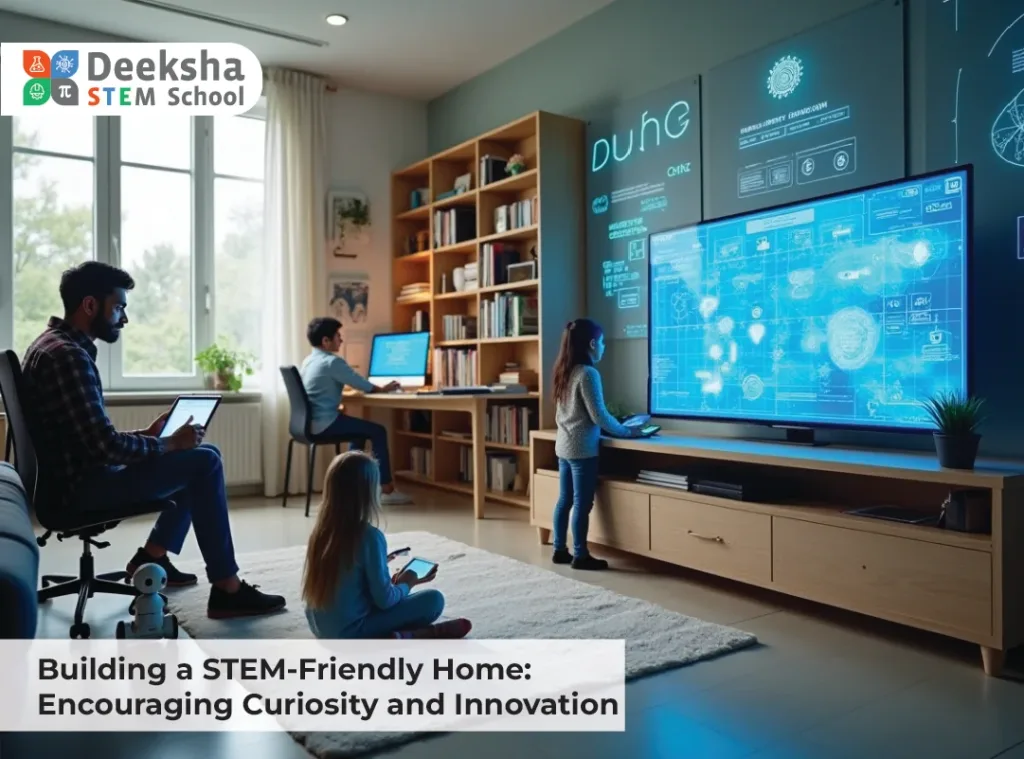
Setting Up a STEM-Friendly Home Environment
Create small, accessible spaces that invite exploration without overwhelming you or your child.

Designating a STEM Corner
Choose a low-shelf area or a small table where materials are easy to reach. Rotate materials to maintain novelty.

Essential Materials for Home STEM
Stock up on affordable, multipurpose materials. Most items are household staples.
| Category | Examples | Use Cases |
|---|---|---|
| Loose Parts | Buttons, bottle caps, beads | Sorting, patterning, counting, art |
| Containers | Measuring cups, jars, ice cube trays | Volume exploration, measuring, pouring |
| Building | Blocks, cardboard, tape | Engineering, balance, design challenges |
| Nature | Rocks, leaves, shells | Sorting, classification, life cycles |
| Simple Tech | Magnifier, digital camera, simple robot kit | Observation, documenting, early coding concepts |
Daily Routines That Build STEM Thinking
Integrating STEM into routines normalizes scientific thinking. Here are small daily habits with big impact.
Meal Time Math and Science
Walks and Outdoor Exploration
Clean-Up as Engineering
Hands-On STEM Activities by Age Group
Below are curated activities for ages 3–5 and 5–8. Each activity lists materials, steps, learning goals, and extension ideas.
Activities for Ages 3–5 (Preschool)
1. Sink or Float Exploration
Materials: a tub of water, various small objects (spoon, leaf, cork, coin), towel.
Learning goals: observation, making predictions, sorting, counting. Extension: introduce a simple vocabulary word—density—by describing heavy vs. light for size.
2. Building Bridges with Blocks
Materials: wooden blocks, toy cars, small stuffed animals.
Learning goals: engineering design process (plan, build, test, improve), spatial reasoning. Extension: add weight to the bridge and discuss load-bearing.
3. Nature Pattern Collage
Materials: leaves, sticks, pebbles, glue, paper.
Learning goals: pattern recognition, fine motor skills, vocabulary. Extension: photograph patterns and create a pattern book.
Activities for Ages 5–8 (Early Elementary)
4. Paper Airplane Engineering Challenge
Materials: paper, tape, measuring tape, target markers.
Learning goals: hypothesis testing, measurement, data recording. Extension: Graph flight distances and discuss averages.
5. Simple Coding with Sequence Cards
Materials: index cards, marker, small toys (figure or car).
Learning goals: sequencing, algorithmic thinking, debugging. Extension: introduce free kid-friendly apps (offline options available) for block-based coding.
6. Homemade Weather Station
Materials: thermometer, notebook, container for rain gauge, wind sock (DIY from paper and tape).
Learning goals: data collection, pattern recognition, cause-and-effect. Extension: compare your observations with a local weather report and discuss differences.
Guided Inquiry: Asking Better Questions
Encourage open-ended questions that prompt thinking rather than yes/no answers. Use scaffolding to deepen exploration.
Integrating Language and Literacy with STEM
Combining STEM and language skills strengthens both. Use storytelling to describe experiments and label diagrams to connect words with concepts.
Addressing Screen Time: Balanced Tech Use
Technology can enhance learning when used purposefully. Prioritize hands-on experiences and choose quality screen activities when appropriate.
Assessment and Tracking Progress at Home
Assessment with young children should be informal and observational. Keep records that celebrate growth rather than label performance.
Inclusion: Making STEM Accessible for All Learners
Be intentional about inclusive practices so every child can participate and succeed.
Safety and Supervision Guidelines
Ensure activities are safe and age-appropriate. Supervision is essential for experiments and when using small parts.
Sample Weekly STEM Schedule (Flexible, 20–45 minutes/day)
This sample routine balances play, exploration, and structured challenge. Adjust timing and intensity for your child.
h2>Case Studies and Real-World Examples
Here are three brief, real-world snapshots showing how families integrate STEM at home.
Case Study 1: The Busy Baker
A parent used weekly baking to teach fractions, measurement, and chemical changes. The child measured cups, compared halves and quarters, and observed dough rising—growing both math skills and descriptive vocabulary.
Case Study 2: Backyard Engineers
A family built bird feeders and ramps for toy cars, documenting designs with photos. The child learned iteration—improving designs based on observation—and practiced counting and weight comparisons.
Case Study 3: The Neighborhood Scientists
Neighbors formed a monthly nature club where children recorded local weather, tracked plant growth, and compared notes. Collaborative data recording introduced ideas of consistency and community science.
Resources: Books, Apps, and Websites
Suggested resources to extend learning. These are reputable, free or low-cost options appropriate for early learners.
Internal and External Linking Recommendations
For SEO and user navigation, include these internal and external links:
SEO Optimization & Keyword Strategy
Primary keyword target: “STEM learning at home for early learners” (aim for 1–2% density). Secondary/LSI keywords to use throughout headings and body: early STEM activities, STEM at home preschool, hands-on STEM projects, STEM for kids ages 3–8, early childhood STEM.
Sprinkle question-based phrases for voice search: “How can I teach STEM at home?” “What are easy STEM activities for preschoolers?”
Frequently Asked Questions (FAQ)
What age is best to start STEM at home?
Anytime—infants and toddlers benefit from sensory exploration and problem-solving; ages 3–8 are ideal for more structured play-based STEM activities.
Do I need special skills to teach STEM at home?
No. Curiosity and a playful attitude matter more than content knowledge. Use simple prompts, ask questions, and learn alongside your child.
How much screen time is appropriate for STEM learning?
Limit passive screen use and favor short, interactive experiences (10–20 minutes) that complement hands-on activities. Co-viewing improves learning outcomes.
Measuring Success: What to Look For
Success in early STEM is behavioral and developmental, not test scores. Look for signs like:


0 Comments