
Nurturing Emotional Intelligence: Teaching Kids to Recognize and Express Feelings Through Coloring
Primary keywords: emotional intelligence for kids, coloring to express feelings, teach kids emotions
Introduction (What you’ll learn)
Emotional intelligence is one of the most important skills children can develop—helping them manage emotions, build healthy relationships, and succeed academically and socially. Coloring, a simple, accessible activity, can be transformed into a powerful, evidence-informed tool for helping kids recognize, name, and express their feelings. In this article you’ll learn why coloring supports emotional development, practical activities and lesson plans for different age groups, specific prompts and coloring templates to try, tips for educators and parents, measurable outcomes, case studies, and resources. Whether you’re a parent, preschool teacher, counselor, or therapist, this guide gives actionable strategies to use coloring intentionally to nurture young emotional intelligence.
Why Coloring Helps Build Emotional Intelligence (EI) in Children
Coloring supports EI by combining sensory regulation, creative expression, and verbal reflection. Here are the core reasons it works:
- Low-pressure expression: Coloring is non-verbal and non-judgmental, allowing children to express feelings they don’t have words for yet.
- Self-regulation: The focused, repetitive motions involved in coloring can calm the nervous system and reduce anxiety, creating readiness to reflect on emotions.
- Symbolic representation: Colors, shapes, and intensity become symbolic tools kids use to represent inner states (e.g., dark colors for sadness).
- Language scaffolding: Guided questions while coloring help children map emotions to words, expanding their emotional vocabulary.
- Social learning: Group coloring activities promote empathy, perspective-taking, and communication about feelings.
- Introduce 4–6 basic feelings using picture cards (happy, sad, angry, scared, calm, surprised).
- Give each child a face template and ask them to color a face for a selected feeling.
- Encourage them to show and name the feeling and one time they felt it.
- Optionally create a classroom feelings wall with their colored faces.
- Introduce or review 8–12 feeling words with child-friendly definitions.
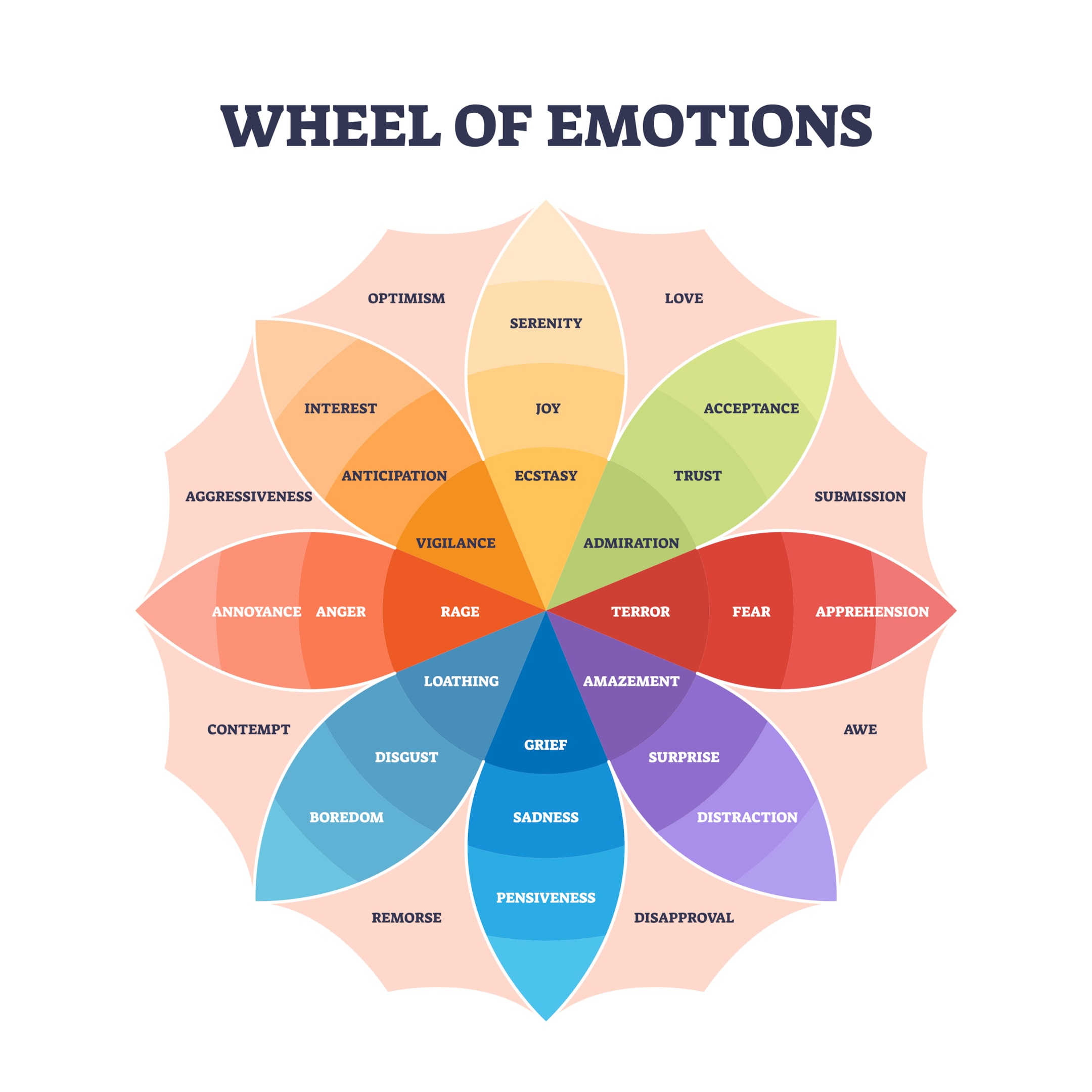
- Have children color sections of a feelings wheel using colors they associate with each emotion.
- Provide story scenes (e.g., playground, bedtime, classroom). Ask children to color the scene focusing on a chosen character’s emotion and explain why.
- Introduce the concept of a mood map—a daily visual record of emotions using color intensity and placement.
- Each day, students color a small page noting mood, triggers, and any actions taken.
- Weekly, review entries to notice patterns and set small goals (e.g., “I will take three deep breaths when I feel stressed”).
- Introduce narrative coloring—choose a complex page and assign emotions or life themes to sections.
- Students create an “emotion map” of their week or a significant event using color, texture, and annotations.
- Host guided group reflections where students share insight while respecting privacy (options for anonymous sharing available).
- “Color your calm.” Ask the child to color shapes that show what calm looks like to them. Follow with: “What helps you feel calm?”
- “Draw your worry monster.” Color it, then list one small step to make it smaller.
- “Color a place where you feel safe.” Discuss sensory details—what do you hear, smell, feel there?
- “Happy to Angry Timeline.” Color a sequence of faces or scenes showing how feelings changed during the day.
- “Color the weather of your mood.” Match moods to weather (sunny, stormy, cloudy) and explain why.
- Create a routine: Start or end the day with a 10–15 minute coloring check-in to normalize emotional check-ins.
- Designate a calm corner: A small area with coloring supplies and mood prompts where students can self-regulate.
- Encourage choice: Offer various templates and supply colors so children have autonomy—choice fosters empowerment.
- Model reflection: Teachers should occasionally color with the class and model naming their own feelings and coping strategies.
- Respect privacy: Some children won’t want to share—offer anonymous sharing options like a feelings box or gallery wall with numbers instead of names.
- Differentiate: Provide tactile options (markers, crayons, textured paper) and alternative expression methods (sticker charts, comics) for diverse learners.
- Make it predictable: Use coloring as part of a bedtime wind-down or after-school transition to help kids decompress and talk about their day.
- Ask open questions: Instead of “Are you okay?” try “What color would you use for today and why?”
- Create a feelings kit: Include coloring pages, crayons, a feelings wheel, and coping cards with strategies like breathing or counting.
- Use technology thoughtfully: Printable coloring pages and apps can be tools, but prioritize offline, hands-on coloring for regulation.
- Avoid minimizing emotions: If a child colors heavy or dark, resist comments like “It will be fine”—ask gentle questions and validate their feelings.
- Increased ability to name emotions during check-ins.
- Shorter recovery time after frustration or upset.
- More use of coping strategies learned during activities (deep breathing, taking breaks).
- Greater willingness to engage in peer sharing or role-play.
- Weekly mood maps: Students color daily mood squares—look for pattern changes over 4–6 weeks.
- Pre/post self-report scales for older kids (simple 1–5 feeling recognition/confidence scales).
- Teacher/parent behavior checklists focusing on specific targets (e.g., naming feelings, using coping strategies).
- Feelings wheel (8–12 emotions) with color suggestions
- Daily mood map (7-day grid with space for color and one sentence)
- Emotion comic strip template (three panels: feeling, trigger, coping)
- Calm-down mandala (simple or complex versions)
- “Worry monster” drawing sheet with shrink/grow prompts
- “Feelings wheel coloring template with labeled emotion sections”
- “Child coloring a mandala in a school calm corner”
- “Emotion comic strip example colored by an elementary student”
- Prefer apps that encourage reflection prompts and journaling, not just passive coloring.
- Use printable exports from apps to enable offline reflection and sharing.
- Limit screen time during emotional regulation activities; hands-on coloring is often more grounding.
- Use apps for accessibility—text-to-speech and adjustable contrast help neurodiverse learners.
- Anchor: “social-emotional learning activities” — Link to a site’s existing SEL activities page
- Anchor: “classroom calm down corner ideas” — Link to a practical classroom setup article
- Anchor: “parenting tips for emotion coaching” — Link to a parenting advice hub
- American Psychological Association — article on emotion regulation for children (open in new window)
- Collaborative for Academic, Social,

Research and Evidence
Studies in child development and art therapy show that creative activities can reduce stress, support verbalization of feelings, and improve emotional regulation. Research in art therapy has found that art-based interventions are effective for emotional expression in children, often facilitating breakthroughs where talk therapy alone may be difficult. While coloring specifically has been studied mostly in adults for stress reduction, the underlying mechanisms (focused attention, sensory input, symbolic expression) are applicable to children.

Core Emotional Skills Targeted by Coloring Activities
When used intentionally, coloring can build specific EI skills. Each activity below maps to targeted competencies:
| Emotional Skill | What It Looks Like in Kids | Coloring-Based Activity Example |
|---|---|---|
| Emotion recognition | Identifying and naming feelings | Color-and-name feelings wheel |
| Emotional vocabulary | Using words beyond “happy/sad” | Color-coded feeling word bank |
| Self-regulation | Calming down when upset | Breathing with coloring mandalas |
| Empathy | Understanding others’ feelings | Partner coloring with feeling prompts |
| Problem-solving | Managing interpersonal conflict | Story-based coloring: “What happens next?” |

Age-Appropriate Coloring Activities and Lesson Plans
Below are detailed, actionable activities tailored by age group—each with goals, materials, steps, reflection prompts, and extension ideas.

Preschool (Ages 3–5): Feeling Faces and Color Matching
Goals: Build emotion recognition and start linking colors to feelings.
Materials: Simple face templates, crayons/markers, feeling cards with photos, color swatches.
Steps:
Reflection prompts: “What color did you choose for sad? Why?”
Extensions: Use a feelings chart for daily check-ins or create a color-coded feelings jar.
Early Elementary (Ages 6–8): My Feelings Wheel and Story Scenes
Goals: Expand emotional vocabulary; connect feelings to situations.
Materials: Feelings wheel template, scene illustrations, colored pencils, emotion word bank.
Steps:
Reflection prompts: “What color shows that someone is frustrated? How would you help them?”
Extensions: Turn wheels into personal coping plan charts (e.g., “When I’m angry, I can…”).
Upper Elementary (Ages 9–11): Emotional Journals and Mood Maps
Goals: Support self-awareness, pattern recognition, and written reflection.
Materials: Coloring journals, mood map templates, gel pens, stickers.
Steps:
Reflection prompts: “What patterns do you see? Which emotion happens most on Mondays?”
Extensions: Combine with goal-setting and peer-sharing sessions focused on coping strategies.
Adolescents (Ages 12+): Narrative Coloring, Identity, and Emotion Mapping
Goals: Deepen emotional insight, support identity exploration, and practice interpersonal empathy.
Materials: Complex coloring pages (cityscapes, abstract patterns), mood mandalas, journaling prompts, music for mood-setting.
Steps:
Reflection prompts: “How did the colors change as the story progressed? What does that reveal about shifts in feeling?”
Extensions: Integrate art therapy techniques such as safe container drawing and use in counseling settings with parental consent.
Practical Coloring Prompts to Teach Emotional Literacy
Use these tested prompts to guide children through meaningful reflection while they color. Prompts are adaptable by age.
Classroom and Group Implementation Tips
Coloring for EI can be scaled to classroom settings. Use these practical tips for teachers and program leaders.
Tips for Parents: Using Coloring at Home to Support EI
Parents can easily integrate coloring into daily routines to boost emotional skill-building.
Measuring Progress: How to Know Coloring Interventions Are Working
To evaluate whether coloring activities are helping build EI, use both informal and formal measures:
Informal Observations
Simple Tools for Tracking
When to Consult Professionals
If coloring reveals persistent severe emotional distress—frequent suicidal talk, extreme withdrawal, or aggressive behaviors—refer to a school counselor or mental health professional. Coloring is a tool, not a replacement for therapy when clinical intervention is needed.
Case Studies and Real-World Examples
Below are brief illustrative case studies showing how coloring was used intentionally to support EI in different settings.
Case Study 1: Preschool Classroom—”Feelings Faces Wall”
A preschool teacher introduced monthly feelings themes and weekly coloring sessions. Children created a feelings wall, and during circle time they pointed to their colored face to show how they felt. Over a semester, the teacher noted fewer tantrums and more children successfully using verbal prompts like “I’m sad” or “I need a hug.”
Case Study 2: Elementary School—”Mood Mapping Club”
An after-school program implemented mood-mapping with coloring journals for 30 fourth-graders. Facilitators guided students to identify triggers and choose coping strategies. After 10 weeks, students reported better problem-solving with peers and teachers observed improved conflict resolution during recess.
Case Study 3: School Counseling—”Narrative Coloring for Grief”
A school counselor worked with middle-school students who had experienced a loss. Narrative coloring and guided reflection allowed students to express complex emotions non-verbally. The counselor used these pieces to open conversation, leading to group sessions where students supported each other’s coping strategies.
Templates and Resource Suggestions (Printable Ideas)
Provide parents and educators with ready-to-use templates that support emotional learning:
Image alt text suggestions:
Integrating Technology and Apps Without Losing the Benefits
Digital coloring apps can supplement offline activities, especially for older children who enjoy tech. Keep these guidelines in mind:
Common Challenges and How to Solve Them
Even with the best intentions, barriers arise. Here’s how to address common issues:
Child Refuses to Color or Share Feelings
Offer choices (different pages, materials). Normalize privacy—sharing should be optional. Use indirect prompts like “Show me with color” rather than requiring words.
Children Use Disturbing Imagery
Stay calm. Ask neutral, curious questions: “Tell me about what you drew.” Avoid judgment. If imagery suggests risk, consult counselors and follow safeguarding protocols.
Limited Time or Resources in Classrooms
Shorten activities to 5–10 minutes for daily check-ins. Use inexpensive materials (crayons and photocopied templates). Rotate supplies to maintain novelty.
FAQs (Optimized for Voice Search and Featured Snippets)
How does coloring help children with emotions?
Coloring helps children regulate arousal, represent emotions symbolically, and practice naming feelings in a low-pressure way, which builds self-awareness and coping skills.
What ages benefit most from coloring for emotional learning?
All ages benefit, but activities should be tailored. Preschoolers need basic emotion recognition; teens benefit from narrative and reflective coloring tied to identity.
How often should kids color to improve emotional intelligence?
Consistency matters more than duration. Short daily or several-times-weekly sessions (5–20 minutes) are effective for building awareness and habits.
Are there risks to using coloring for emotional expression?
Coloring is low-risk but not a substitute for professional help. If a child’s coloring repeatedly indicates severe distress, seek a qualified mental health professional.
SEO and Internal/External Linking Suggestions
Internal link suggestions (anchor text recommendations):
External authoritative link suggestions:


0 Comments